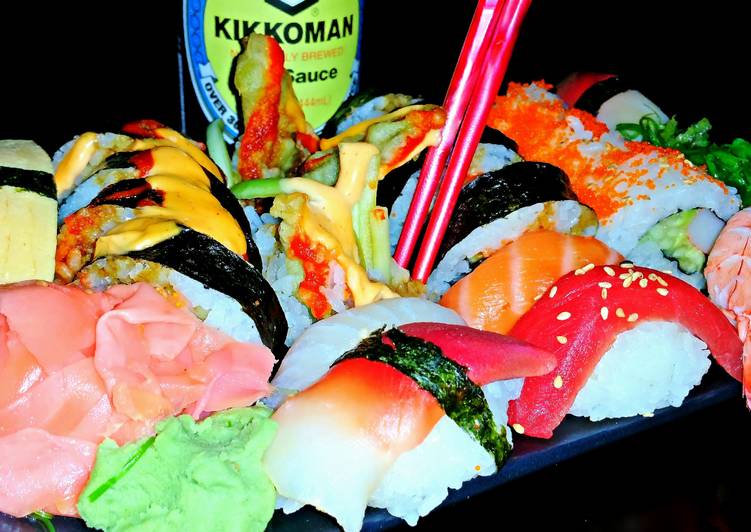
Hello everybody, I hope you are having an incredible day today. Today, we’re going to make a distinctive dish, mike's sushi school 101. One of my favorites food recipes. For mine, I am going to make it a bit tasty. This is gonna smell and look delicious.
Best sushi in the area by a long shot. Staff was very friendly and the sushi was amazing. Happy to have found a place close to my home!
Mike's Sushi School 101 is one of the most favored of recent trending foods in the world. It is easy, it’s quick, it tastes delicious. It’s enjoyed by millions daily. They’re fine and they look fantastic. Mike's Sushi School 101 is something that I’ve loved my entire life.
To get started with this recipe, we must prepare a few components. You can cook mike's sushi school 101 using 8 ingredients and 5 steps. Here is how you can achieve that.
The ingredients needed to make Mike's Sushi School 101:
- Make ready Traditional & Reverse California Rolls
- Prepare 1 A Love Of Sushi & Sashimi
- Make ready 2 Art Appreciation
- Make ready 3 Determination
- Prepare 4 Creativity
- Prepare 5 Patience
- Make ready 6 Time
- Take 7 Lastly, remember this. If preparing Sushi were an easy art, it would be called, "Rice n' stuff." ;0)
Watch TV shows and movies online. Stream TV episodes of Grey's Anatomy, This Is Us, Bob's Burgers, Brooklyn Nine-Nine, Empire, SNL, and popular movies on your favorite devices. Sushi rolls are all I ever want in a sushi restaurant, not that I ever go to sushi restaurants, but still. During the course of our sushi unit here on PW Cooks, we're going to learn to make several different sushi rolls, each increasing in both complexity and decadence.
Instructions to make Mike's Sushi School 101:
- THE DEFINITION OF SUSHI - - "A Japanese dish consisting of small rolls of vinegar flavored, cooked rice usually served at room temperature or, chilled with a garnish of raw fish, [or, Sashimi] vegetables or eggs." - - * Chef's Note: Fruits & meats are at times utilized in Sushi, but rarely so. - - SUSHI RICE DIRECTIONS - - #1 White rice, [or, Hakumai] is considered by Japanese Chefs, [or, Itamaes] as the most vital aspect of Sushi. Without question, it's widely believed to be, "The Soul of Sushi," if you will. - - The proper preparation of sushi rice is so important to the Japanese that Itamaes spend their first two years of their seven year apprenticeship perfecting sushi rice alone. - - Curiously enough, brown sushi rice [or, Genmai] isn't as common place in Sushi dishes. However, it is gaining popularity in both Japan & the US for not only its earthy taste but texture & health benefits as well. In fact, you may have recently heard of Spam Sushi wrapped in seaweed, [or, Nori] & Genmai made popular by
- SUSHI ROLL ASSEMBLY, SUSHI FILLERS & PLATE SERVICE - - DIRECTIONS FOR THE REVERSE CALIFORNIA ROLL - [seaweed on the outside] - - #17 Place your seaweed, [or, Nori] on your clean, Ziplock sealed bamboo mat with the shiny side of your Nori facing down. Wet your fingers with your bowl of water & shake off excess before picking up any sticky rice. Do this at regular intervals as the rice will continually stick to your fingers. - - Begin adding your sticky rice to your Nori in the middle of it. Don't pack or smear the rice, you'll only break it. Just gently tap the rice down at approximately 1/4" in thickness. - - Spread your rice to all edges and corners of yourNori but stop spreading rice layer 90% of the way AWAY from you at the furthest end of your Nori. You'll need this empty lip to seal your Sushi. - - #18 At this point, you'll be looking down at a square piece of seaweed that is 90% covered wall to wall in warm rice & 10% of the end FURTHEST away from you should be completely clean. - - #19 Now, at 1"
- SUSHI PRESENTATION - - #35 There are five primary points to remember before making sushi. These are flavor, freshness, color, texture & presentation. Each, I assue you, are equally important. With that said, let's focus for a second on presentation regarding both the Sushi & the serving plates. For starters, try to pick contrasting colors that compliment one another when serving your guests their meal. - - #36 Don't just throw your Sushi on a forgettable plate wily nilly. Consider how important a colorful presentation is. Especially since the natural, vivid colors of Sushi can literally force your plate appear more vibrant & alive! Always remember, we feed with or eyes before we do our mouths! - - * Chef's Note: Not only are sushi dishes one of the most photographed by diners, more often than not, when presented skilfully & artfully, they're quite the conversation starter! - - For instance, consider a Okonomi Tuna strip. Imagine its naturally deep yellow squash color atop a pristine bed of white r
- SUSHI PRECAUTIONS - - #39 Make certain to keep all seafood & their juices away from every other item [utensils & counter tops, food or otherwise] until you're ready to assemble your rolls. Cross contamination can easily result in food poisoning & is a real concern in Sushi preparation. - - Conversely, while safety would dictate you wear gloves throughout the preparation of Sushi & Sashmi, I wouldn't recommend them. Seafood preparation being the only exception. - - Sushi is just one of those foods you have to completely feel to get right. Especially with Nigiri Sushi & the hand molding required. You need to feel the weight, texture & temperature of the rice to successfully work with it. Just wash up well & regularly. - - Separation of seafood products is also important for those with allergies to shellfish. For guests with minor shellfish allergies, a good practice is to create all of your non-seafood rolls first, plate them up & set far to the side long before you touch anything seafood related.
- THE DEFINITION OF SASHMI - - "A Japanese dish of bite sized pieces of raw fish eaten with Soy Sauce and Wasabi paste." - - #44 To clarify the quote above, while raw pieces of fish served alone with no rice are indeed called, "Sashmi," know that Sashmi can also placed upon elongated balls of rice. These bites are called, "Okonomi Sushi." However, if served over rice, this method is still referred to as Sushi or Zushi. [see #47] - - #45 The most popular Sushi related seafoods in the US are listed in no particular order as Salmon, Yellow Fin, Yellow Tail, Blue Fin, Uni, [sea urchin] Fatty Tuna Belly, Roe, Spiny Lobster Tail, Prawn, Crab, Clam, Oyster, Snapper, Scallop, Halibut, Eel, Octopus & Mackerel. - - Shrimp & Imitation Crab Meat [or, Kani Kama] are amongst the most popular pre-steamed options. Kani Kama is usually made with pressed Pollock or generic white fish & is regularly substituted for real crab meat. It's most commonly found in the California Roll. This white fish will also last longer
After studying food science at university and French cuisine at Le Cordon Bleu Paris, she learned authentic sushi at Tokyo Sushi Academy. Sushi Den is thought to be the one of the first sushi bars importing fish on a larger scale. People in Japan eat it in the morning like people eat scrambled eggs in the US. It is also a favorite for bento boxes for lunch and with other foods like sushi. Another nice thing is that it looks very nice and holds its shape well.
So that’s going to wrap this up with this exceptional food mike's sushi school 101 recipe. Thank you very much for reading. I am sure that you can make this at home. There is gonna be interesting food in home recipes coming up. Don’t forget to save this page in your browser, and share it to your loved ones, colleague and friends. Thanks again for reading. Go on get cooking!